

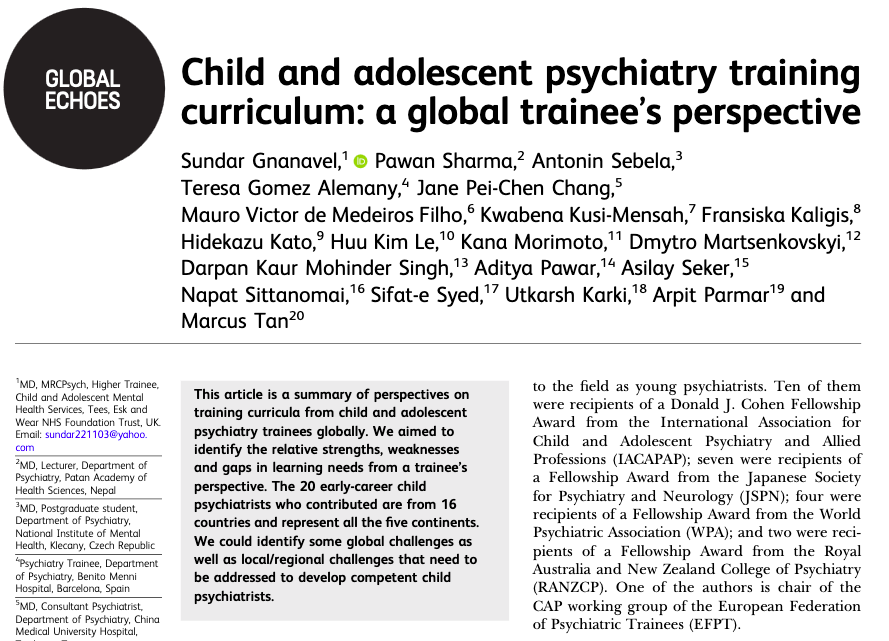
In 2015, a meta-analysis estimated the worldwide pooled prevalence of child and adolescent mental health disorders at 13.4%.1 It is estimated that approximately half of the population with mental health disorders experience illness onset at or before 14 years of age.2 The number of trained child and adolescent mental health professionals has been extremely low, particularly in low- and middle-income coun- tries. 3 A number of countries do not have specia- lised child and adolescent mental health training programmes. Instead, general psychiatrists and paediatricians try to partially fill in the void. It is also a well-recognised fact that across those coun- tries that offer training in child psychiatry, the content and breadth of the curriculum is extremely variable and inconsistent. 4 This article is a summary of perspectives from child and adolescent psychiatry (CAP) trainees across the globe regarding their respective train- ing curricula. The contributors include 17 young child and adolescent psychiatrists from 16 countries currently working on the five conti- nents: Asia: Bangladesh, Japan, India, Indonesia, Nepal, Taiwan and Thailand; Africa: Ghana; Oceania: Australia; Europe: the Czech Republic, Spain, Ukraine, the UK and Turkey; America: Brazil and the USA.
Download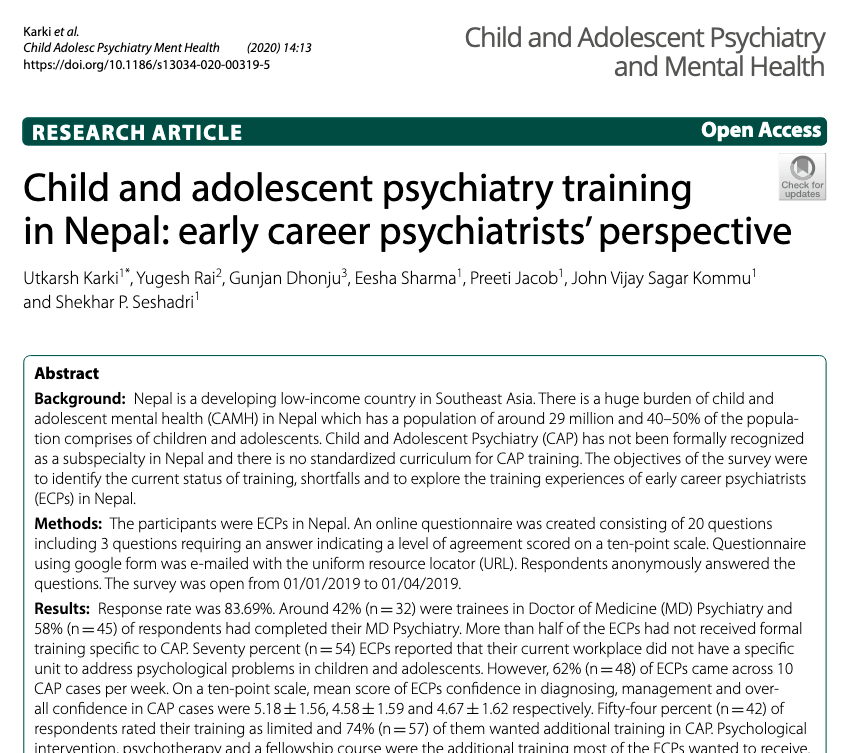
Nepal is a developing low-income country in Southeast Asia. There is a huge burden of child and adolescent mental health (CAMH) in Nepal which has a population of around 29 million and 40–50% of the popula- tion comprises of children and adolescents. Child and Adolescent Psychiatry (CAP) has not been formally recognized as a subspecialty in Nepal and there is no standardized curriculum for CAP training. The objectives of the survey were to identify the current status of training, shortfalls and to explore the training experiences of early career psychiatrists (ECPs) in Nepal.
Download Read MoreUtkarsh Karki, Satish C Girimaji, Shekhar P Seshadri Address for correspondence: Department of Child and Adolescent Psychiatry, National Institute of Mental Health and Neurosciences (NIMHANS), Bangalore, 560029, India.
Read More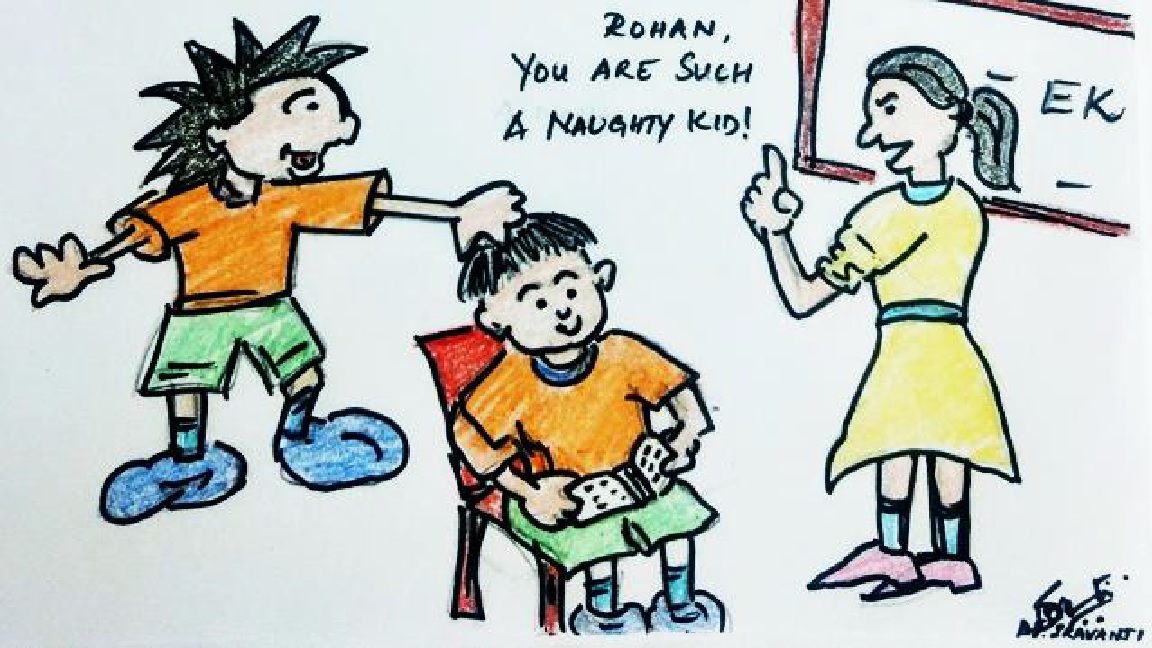
Attention-Deficit/Hyperactivity Disorder (ADHD) is a common neurodevelopmental condition if identified early can ensure less morbidity and better prognosis. It is important to help the child behind the problem and not to look at child as the problem. A holistic approach involving parents as active agents of change will serve the best interests of the child. Therefore, psychoeducation of family members is essential as it helps to improve parental understanding of the condition and reduce punitive responses toward the child. Parents also need to be empowered with behavioural management techniques to manage the problem behaviours stemming from the underlying condition. In this article, we present an illustrated model using a fictional character for psychoeducation of families about ADHD and give an overview of major psychosocial interventions with a focus on environmental modification.
Download
Introduction: Mental health is an integral component of overall health. Various factors along with stigma affect knowledge, perspectives and behavior of the people ultimately affecting help seeking and treatment. The patient and their caregivers are directly involved in overall management and outcome. Hence ascertaining those aspects among them is important and so are aims of this study. Material And Method: A cross sectional comparative study was carried out among 160 participants (80 patients and 80 caregivers) visiting neuropsychiatry outpatient department of a tertiary care hospital. Data was collected through semi-structured proforma and Attitude towards mental illness questionnaire (modified). Data were analysed by using SPSS version 25 and Microsoft excel. Results: The socio-demographic profiles between both groups were similar. About 75% from both the groups had good knowledge about mental illness. Almost 60% from both groups had positive perception/attitude regarding mentally ill and mental illness with an only significant difference in relation to rights to mentally ill. More than 70% from both groups had positive attitude regarding help-seeking with only significant difference in view about people with mental illness seeking help from psychiatrist. About 50% from both groups had positive attitude regarding care and treatment. Conclusion: With good knowledge and positive attitude/perception regarding mental illness, self-stigma persisted regarding some domains. Despite positive attitudes for help-seeking, ambivalent views regarding care and treatment into both groups necessitate easy accessibility and upgrading of mental health services.
Download
Hemolacria or bloody tears is a rare condition resulting from local and systemic causes. Most of the time cause remains unknown and is inferred to be psychogenic in nature. Management includes identification of the cause along with psycho-social intervention. Here I report a rare presentation of bloody tears in a 16 year adolescent female admitted in our inpatient facility with history and discussion.
Download